Commercial & Industrial Energy Storage Solutions
How commercial and industrial facilities in India use lithium battery storage to manage costs and build resilience.
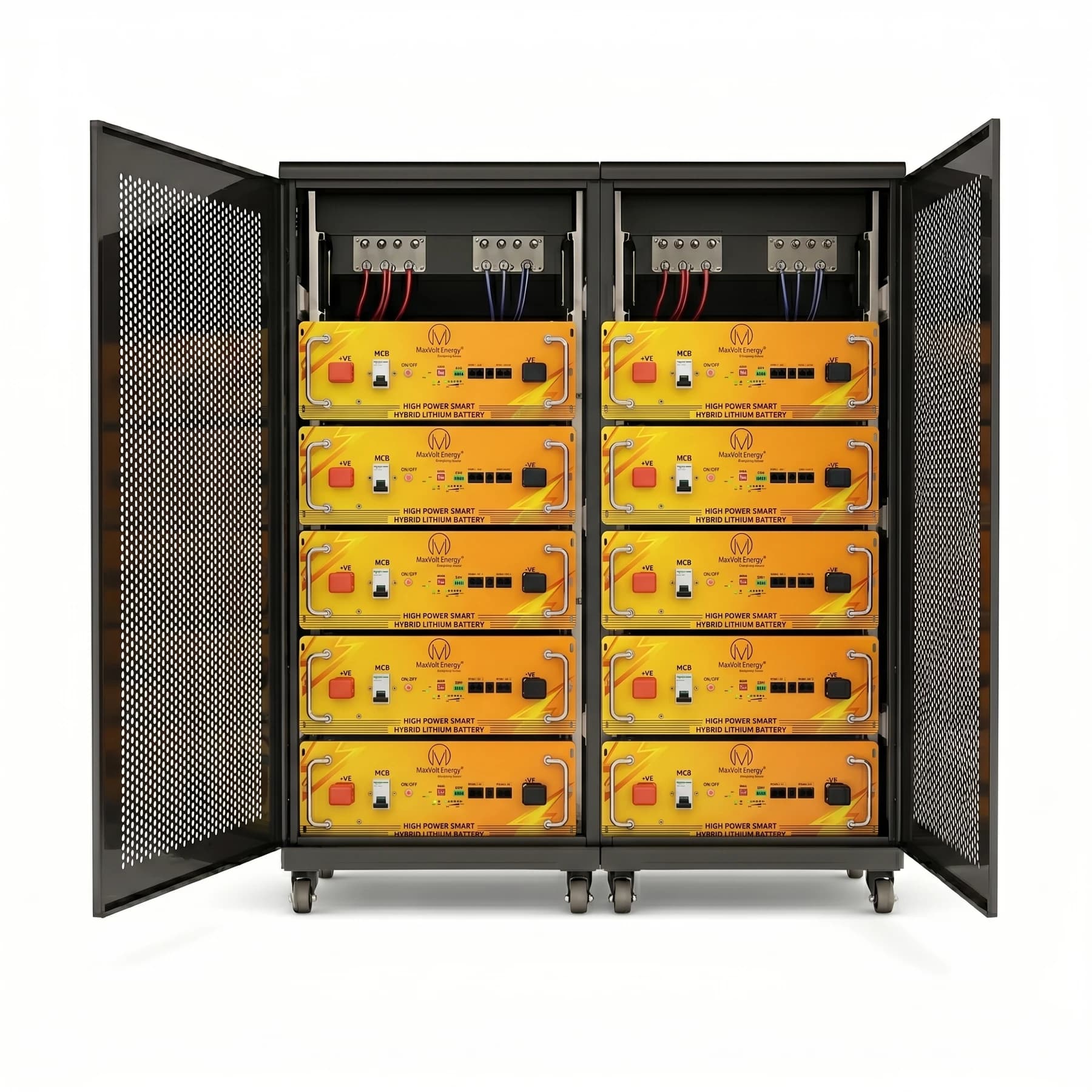
Battery storage has shifted from a backup-only investment to core infrastructure for commercial and industrial (C&I) facilities across India, as businesses look to manage rising electricity costs, integrate renewable generation, and reduce exposure to grid instability. Maxvolt has discussed this shift publicly as part of the broader energy storage conversation in India.
Demand-charge management
Many commercial electricity tariffs include demand charges based on a facility's peak power draw, even if that peak lasts only minutes. A properly sized BESS can discharge during peak-demand windows, reducing the billed peak and lowering the demand-charge component of the electricity bill — often one of the most direct financial returns from a C&I storage investment.
Renewable energy integration
Facilities with rooftop or captive solar generation can use storage to shift solar energy generated during the day to cover evening or night-time loads, rather than exporting excess generation to the grid at potentially unfavorable rates or losing it entirely without storage in place.
Energy resilience for critical operations
For facilities where a power interruption has real operational or financial cost — manufacturing lines, cold storage, healthcare facilities, data infrastructure — a properly sized BESS provides seamless backup that a lead-acid legacy system, with its slower response and shorter service life, is less well suited to at scale.
Sizing a C&I system starts with a load profile
Unlike a home system, a commercial deployment typically begins with a detailed load-profile analysis — understanding when and how much power the facility draws throughout the day — before sizing storage capacity to the specific goal (demand-charge reduction, solar shifting, or backup), since these goals imply different sizing logic.
Frequently Asked Questions
What's the typical payback period for a commercial BESS investment?
It varies widely based on the facility's tariff structure, demand-charge exposure, and how the system is used (demand management vs backup vs solar shifting) — a site-specific financial assessment is the only reliable way to estimate payback for a given facility.
Can an existing facility retrofit battery storage without disrupting operations?
In most cases yes — a properly planned BESS installation is designed to integrate with existing electrical infrastructure with minimal operational disruption, though the exact process depends on the facility's existing setup.
Does a BESS need to be paired with solar to be worthwhile?
No — demand-charge management and backup resilience are valid standalone use cases for a BESS even without on-site generation, though pairing with solar typically improves the overall financial case.
Have a Question About Commercial & Industrial Energy Storage Solutions (India)?
Talk to our team for sizing help, pricing, or technical guidance — no obligation.