Smart BMS & App-Monitored Batteries
What a Smart BMS with mobile app monitoring actually does for a lithium battery.
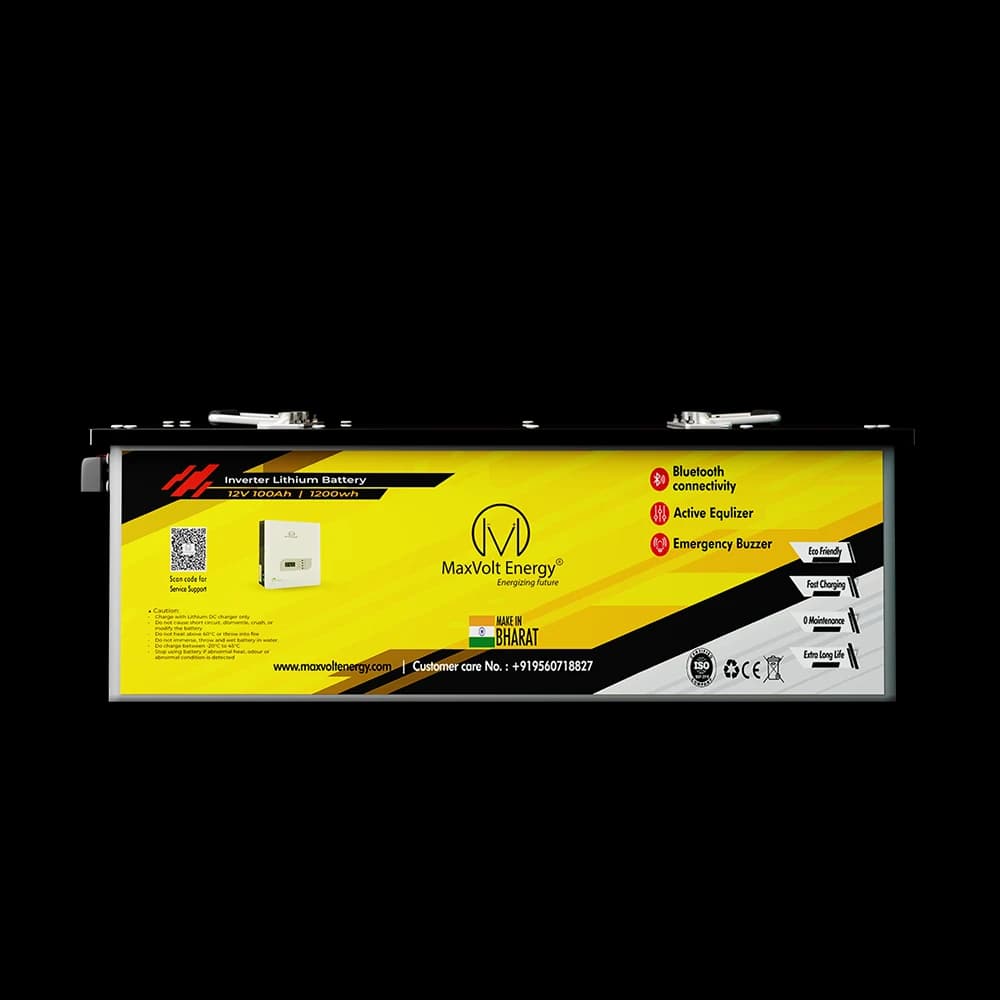
Every lithium battery needs a Battery Management System (BMS) for basic safety — overcharge, over-discharge, short-circuit and temperature protection. A 'Smart' BMS goes further, adding cell-level monitoring and, often, a companion mobile app that shows charge state, health and diagnostics in real time. Maxvolt's Home Inverter Battery and Custom Lithium Battery lines include this capability.
What basic BMS protection covers
At minimum, a BMS prevents the four failure modes that damage lithium cells or create safety risk: charging beyond safe voltage, discharging below safe voltage, drawing excessive current (short-circuit), and operating outside a safe temperature range. This is standard on any reputable lithium battery, branded 'smart' or not.
What app monitoring adds
Real-time visibility into state of charge, estimated remaining backup time or range, individual cell voltage balance (an early indicator of a developing fault before it becomes a failure), cycle count, and temperature — all viewable remotely from a phone rather than requiring a physical inspection. For a home inverter battery, this means knowing your backup status without walking to check it; for a fleet vehicle, it can mean catching a degrading pack before it strands a driver.
Active vs passive cell balancing
Passive balancing bleeds off excess charge from higher-voltage cells as heat to keep a pack's cells even — simple and reliable, though slightly less energy-efficient. Active balancing redistributes energy between cells more efficiently but adds circuit complexity and cost. Either approach, done correctly, meaningfully extends a multi-cell pack's usable life by preventing any single weak cell from limiting the whole pack's capacity.
Frequently Asked Questions
Is a Smart BMS worth paying more for?
For batteries you rely on daily (home backup, commercial EVs), the visibility into developing issues before they cause a failure is generally worth it — for infrequently used or low-stakes applications, a basic protective BMS may be sufficient.
Can app monitoring predict when my battery needs replacement?
It can show declining capacity and cycle count trends over time, which helps anticipate replacement timing — but it's an indicator, not a precise prediction, since real-world degradation varies with usage patterns.
Does every lithium battery come with app monitoring?
No — it's an added feature on select models, not a universal standard. Check the specific product's specifications rather than assuming.
Have a Question About Smart BMS & App-Monitored Lithium Batteries Explained?
Talk to our team for sizing help, pricing, or technical guidance — no obligation.