Data Center Backup Battery Solutions
How lithium battery energy storage supports data center backup power needs.
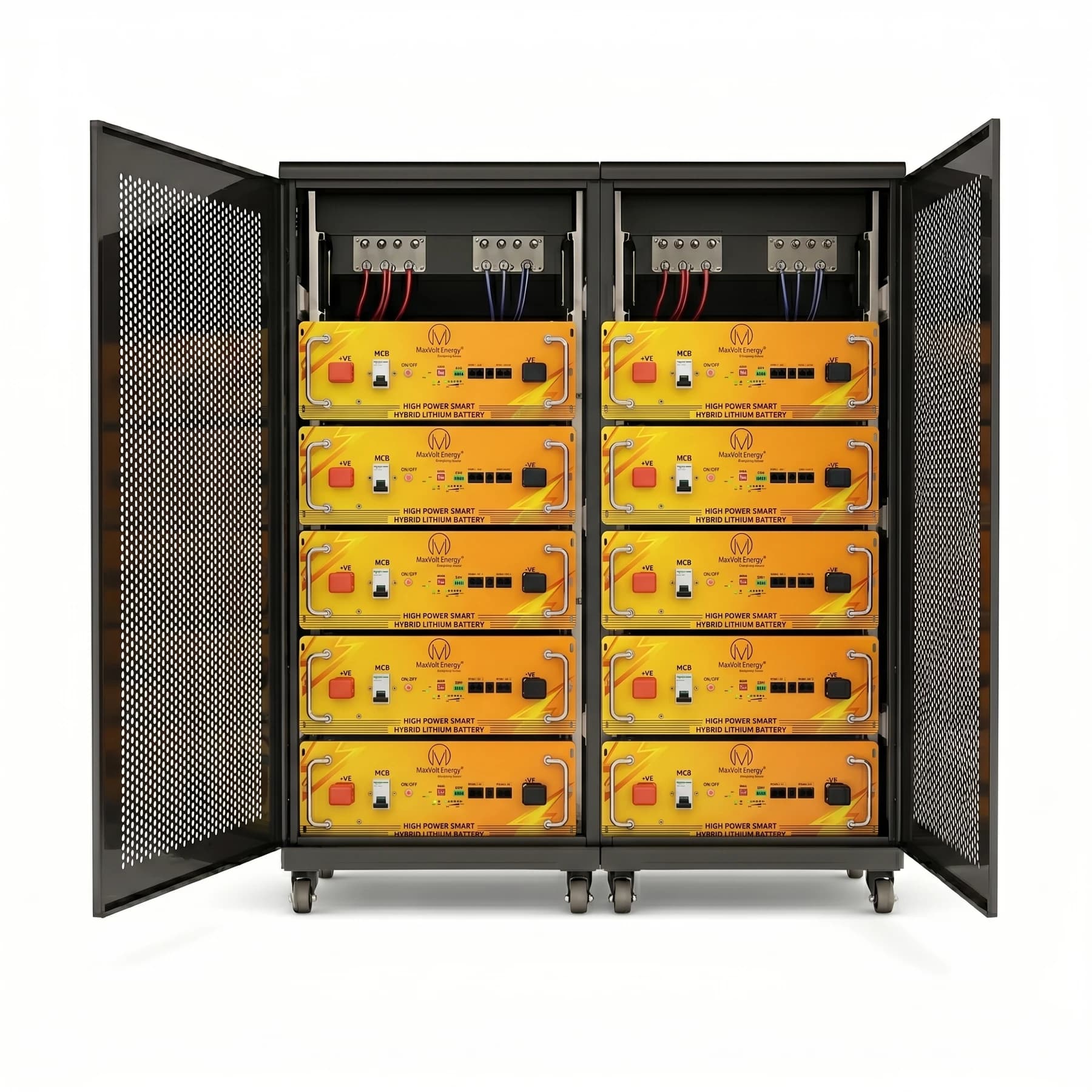
Data centers require some of the most demanding backup power specifications of any facility type — near-zero tolerance for downtime, precise voltage regulation, and battery banks that must perform reliably for years without routine maintenance access to every unit. Lithium battery storage has become an increasingly common choice for this reason.
Why data centers are moving toward lithium backup
Traditional VRLA (lead-acid) UPS battery banks require periodic maintenance, occupy significant floor space per kWh of backup, and typically need replacement every 3-5 years. Lithium LiFePO4 systems offer a smaller footprint per kWh, longer service life reducing replacement frequency and associated downtime risk, and better performance consistency across their service life — all directly relevant to a data center's uptime requirements.
Rack-mount form factor fit
Data centers are already built around standardized server-rack dimensions, making rack-mount lithium battery systems — like Maxvolt's Rack Type Battery, custom-engineered at 48V/96V/120V — a natural fit for integration alongside existing infrastructure without major facility redesign.
What to evaluate for a data center deployment
Remote monitoring and alerting (critical for facilities operated with minimal on-site staff), redundancy and fault isolation (a single cell or module fault shouldn't take down the whole backup capacity), thermal management appropriate for a climate-controlled but still heat-generating environment, and a support relationship capable of responding to a mission-critical facility's uptime requirements.
Frequently Asked Questions
How much smaller is a lithium UPS battery bank compared to lead-acid for the same backup capacity?
Lithium LiFePO4 systems typically require meaningfully less floor space for equivalent backup capacity due to higher energy density and higher usable depth of discharge, though exact space savings depend on the specific systems being compared.
Can lithium battery banks be monitored remotely for a data center?
Yes — modern lithium BESS systems typically include monitoring capability suitable for integration with data center management systems, allowing remote visibility into cell health, temperature and charge state without physical inspection.
How often does a lithium data center battery bank need replacement?
Significantly less often than lead-acid VRLA systems, typically well beyond the 3-5 year replacement cycle common for lead-acid, though exact lifespan depends on usage pattern, temperature and maintenance practices.
Have a Question About Data Center Backup Battery Solutions?
Talk to our team for sizing help, pricing, or technical guidance — no obligation.