E-Rickshaw Battery Price Guide
What e-rickshaw battery prices actually depend on, and lithium vs lead-acid total cost of ownership compared.
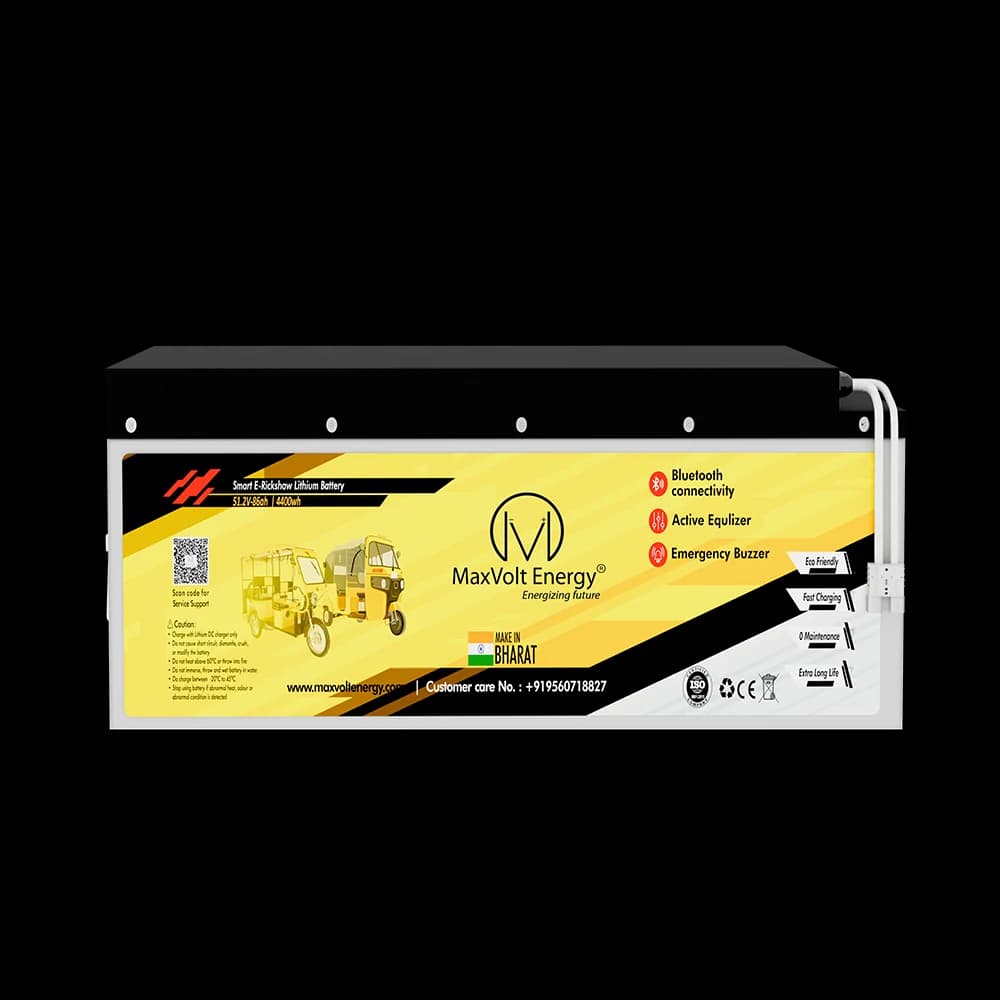
E-rickshaw battery prices in India span a wide range because two very different chemistries compete in this segment — lead-acid and lithium (LiFePO4) — with very different upfront costs and running economics. The sticker price alone is misleading without looking at cost per kilometer over the battery's life.
Lead-acid e-rickshaw batteries: lower upfront, higher running cost
Lead-acid battery packs remain common in the e-rickshaw market due to lower upfront price. But they typically deliver 300-500 cycles, need daily full charging (8+ hours), lose usable range as they age, and require regular water top-ups — all of which add up in a commercial-use vehicle running daily for income.
Lithium (LiFePO4) e-rickshaw batteries
Maxvolt's E-Rickshaw Lithium Battery runs at 51V, 86Ah-100Ah, using LiFePO4 chemistry in a metal case built for the vibration and heat of daily commercial use. Lithium packs typically deliver 2,000-3,000+ cycles — roughly 5-6x a lead-acid pack's cycle life — charge in a fraction of the time (often 2-3 hours vs 8+ for lead-acid), and hold consistent range for far longer as they age.
For a driver whose daily income depends on the vehicle being on the road, less downtime for charging and fewer battery replacements over the vehicle's life are often worth more than the lower upfront lead-acid price.
How to actually compare price: cost per kilometer
Divide the total cost of a battery (including any expected replacements) by its total lifetime kilometers to get a real cost-per-km figure, rather than comparing sticker prices alone. Because lithium typically lasts several times longer per rupee of replacement cost, and charges faster (more paid trips per day), the effective cost per km is frequently lower for lithium despite the higher upfront price — see our fleet operating-cost breakdown for the full math.
Frequently Asked Questions
Why is a lithium e-rickshaw battery more expensive upfront than lead-acid?
Lithium cells and their battery management systems cost more to manufacture than lead-acid, but they deliver far more charge cycles (2,000-3,000+ vs 300-500), faster charging and less downtime — the total cost of ownership calculation usually favors lithium over the vehicle's operating life.
How long does an e-rickshaw lithium battery last?
Typically 3-5+ years of daily commercial use, depending on charging habits and load, versus roughly 1-1.5 years for a lead-acid pack under the same daily use.
Can I retrofit a lithium battery onto an e-rickshaw built for lead-acid?
In many cases yes, provided the voltage matches and the controller/charger is compatible or replaced — check with a qualified installer or the battery manufacturer before retrofitting.
Explore Further
Have a Question About E-Rickshaw Battery Price Guide (India)?
Talk to our team for sizing help, pricing, or technical guidance — no obligation.