Solar Battery Sizing Guide
How to correctly size a lithium solar battery for your home or business — daily consumption, autonomy days, and depth of discharge.
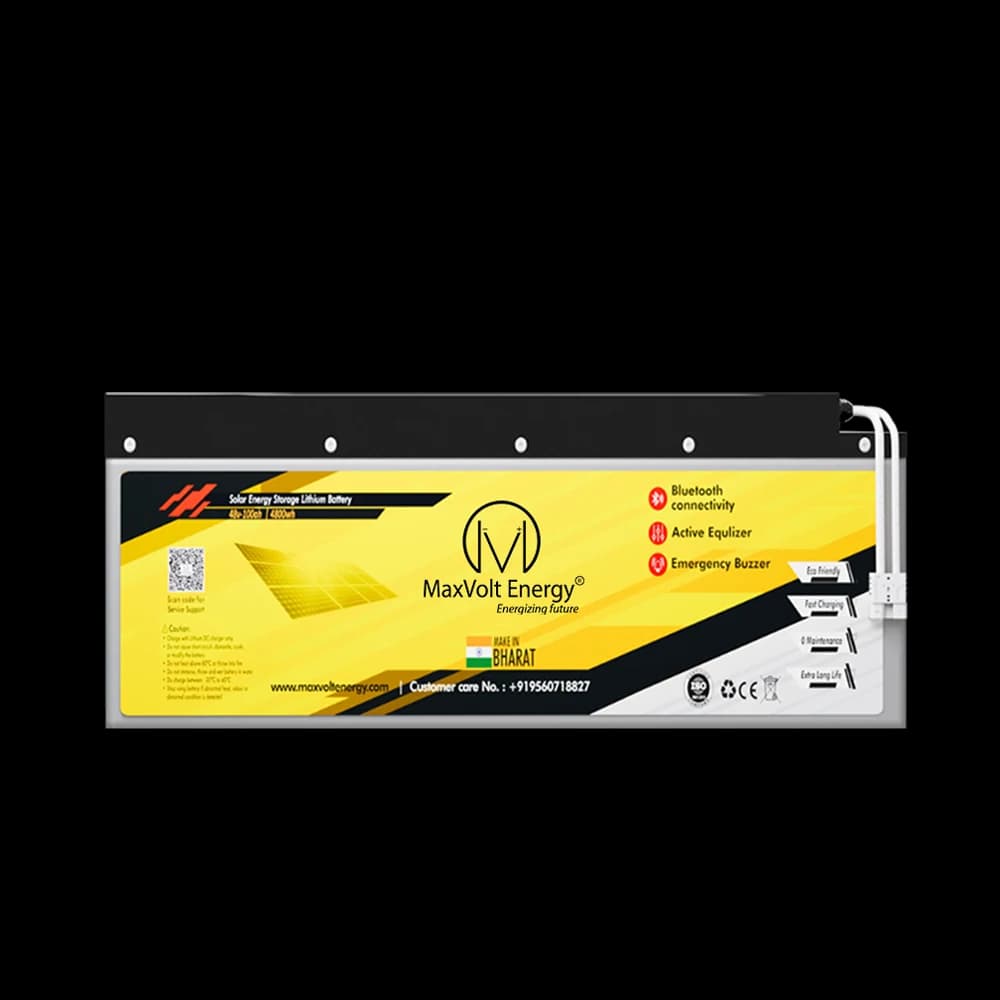
Undersizing a solar battery means running out of stored power before sunrise; oversizing means paying for capacity you rarely use. Getting the size right comes down to four numbers: your daily energy use, how many days of autonomy (no-sun backup) you want, your battery's usable depth of discharge, and your inverter's voltage.
Step 1: Find your daily energy consumption
Check 3-6 months of electricity bills and take the average daily units (kWh) consumed — most Indian discom bills state this directly, or divide the monthly units by 30. If you're sizing for partial backup (critical loads only, not the whole house), list just those appliances' wattage × hours used instead.
Step 2: Decide your autonomy (backup days)
Autonomy is how many cloudy/no-sun days you want the battery to cover without solar input. Most Indian residential systems use 1-2 days of autonomy; off-grid or unreliable-grid locations often go to 2-3 days. More autonomy means more battery — a direct multiplier on cost.
Step 3: Account for usable depth of discharge (DoD)
A battery's rated capacity (Ah) isn't all usable — lithium LiFePO4 batteries like Maxvolt's Solar / ESS range (100Ah-300Ah, 12.8V-51.2V) typically support 80-100% usable DoD, versus roughly 50% for lead-acid. This is a major reason lithium systems can be physically smaller than a lead-acid system rated for the same daily load — you divide your energy need by the USABLE capacity, not the nameplate capacity.
Putting it together: a worked example
Say your daily consumption is 5 kWh (5,000Wh), you want 1.5 days of autonomy, and you're using a 90%-DoD lithium battery at 51.2V. Required storage = 5,000Wh × 1.5 = 7,500Wh. Usable capacity needed = 7,500Wh ÷ 0.90 = ~8,333Wh. At 51.2V, that's roughly 163Ah — so a 200Ah pack at that voltage gives comfortable headroom for battery aging over the years.
Frequently Asked Questions
How many solar batteries do I need for a 3kW system?
It depends on your daily consumption and desired autonomy, not directly on your solar array's power rating — a 3kW array can pair with anywhere from 5kWh to 15kWh+ of storage depending on how many hours of backup you want and how much of your home you're backing up.
Why does depth of discharge matter so much for sizing?
Because it determines how much of a battery's rated capacity you can actually use safely. A lead-acid battery sized for 50% DoD needs roughly double the nameplate Ah of a lithium battery rated for 90-100% DoD, for the same usable energy.
Can I add more battery capacity later if I undersize now?
Depends on the system — modular rack-type or panel-based lithium systems (like Maxvolt's Rack Type Battery) are often designed for future expansion; check with your installer before assuming so, since mixing battery ages/health in one bank isn't ideal.
Explore Further
Have a Question About Solar Battery Sizing Guide (India)?
Talk to our team for sizing help, pricing, or technical guidance — no obligation.